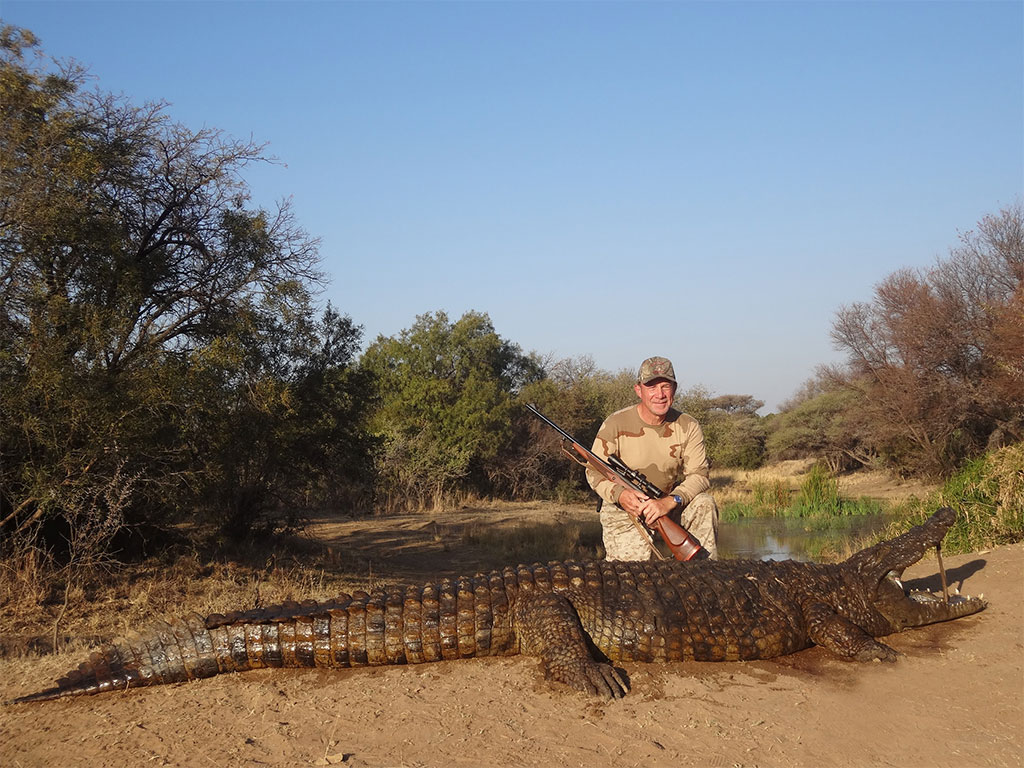
Trophy Hunting Crocodile
Dangerous Game
Crocodile hunting presents a very challenging and enjoyable hunt that will test the marksmanship of any hunter. These great reptiles make a very impressive full mount trophy and should definitely be considered by avid African trophy collectors.
Amazing Facts
- The Nile Crocodile’s bite can exert a force eight times more powerful than that of a great white shark and 15 times more than a Rottweiler’s. Powerful muscles for closing the jaws, however, contrast with small, weak ones for opening them.
- The sex of crocodile hatchlings is determined by the temperature at which the eggs incubate. At 30ºC or less they will be mostly female; at 31ºC they will be mixed; and at 32ºC, they will be mostly male.
Areas in South Africa where Crocodile can be hunted
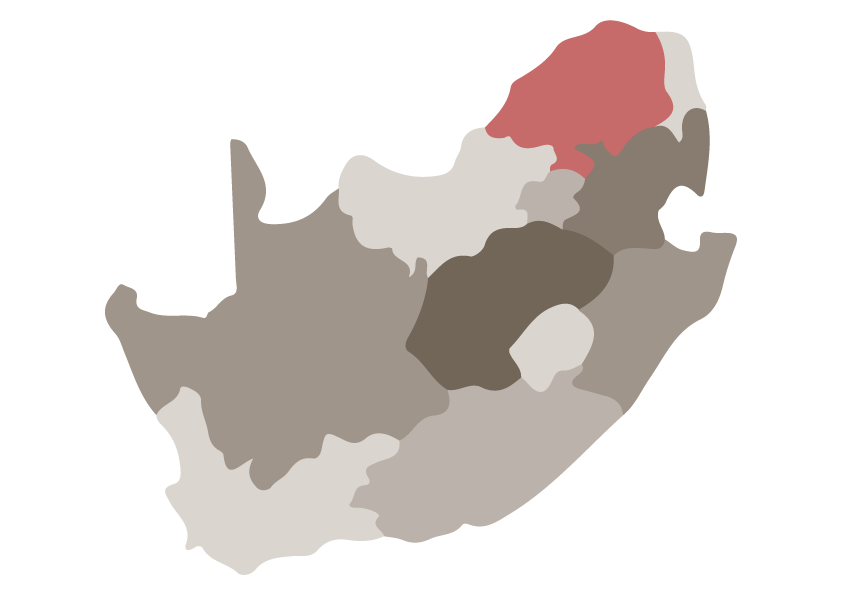
Bushveld
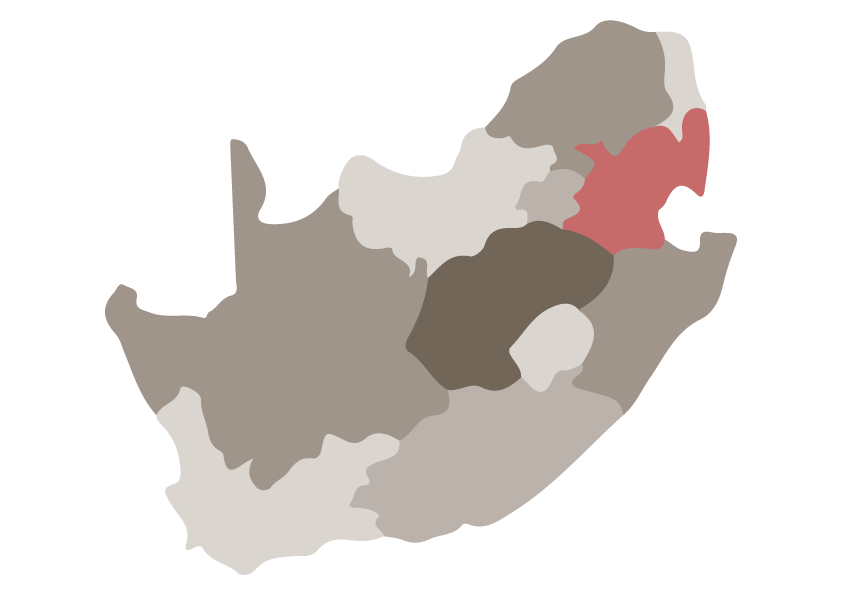
Lowveld
Overview
The Nile crocodile is the largest freshwater predator in Africa and may be considered the second largest extant reptile in the world after the saltwater crocodile (Crocodylus porosus). Colouring range fromdark to bronze to a brownish-black, with a broad snout becoming more noticeable as the animal ages. The crocodile is mostly teeth, tail and appetite. He’s an equal opportunity eater; consuming just about anything he can get into his mouth. He’ll also digest anything he gets down his gullet. Their teeth are hooked and not suitable for chewing. What they are good at is holding on to some part of their new meal’s anatomy. Then they spin until said part of the anatomy is removed. Open goes the mouth and whatever is there disappears down the gullet. If the animal is too big to eat, the Nile crocodile will take it down to the river bottom and stuff it under a convenient tree root until it decomposes to its liking.
Crocodiles, being cold blooded, have to regulate their body temperature by using the sun. They thus spend a lot of time laying on the riverbank soaking up the heat to help raise their internal temperature. They are quite difficult to stalk as they are adept to feeling the vibrations from approaching mammals. So it is important that the approach should be made quietly. If the crocodile hears you coming it will only leave a ripple as it disappears in the water. It is also important that the hunter needs to wait until the crocodile is in such a position where a well-placed shot can enter the vitals. The first shot on the croc must be carefully placed to anchor him, as if he is allowed to retreat to the water, the trophy is surely lost. Only two shots are effective in anchoring your croc; a shot placed into his golf-ball sized brain or one that hits the spinal column just behind the head.
The croc is best hunted from a blind and shot from a solid rest in the prone position. His tough hide and the extremely hard bone encasing the brain calls for a rifle of at least .338 caliber or larger. Use only quality-controlled expansion soft point bullets. Rifles larger than .375 caliber should be avoided, as the recoil from such a weapon shooting from the prone position can be brutal, and thus accurate shot placement becomes an issue. Without question, a quality scope of a least 4-power is essential.
Hunting the trophy crocodile can be an exciting and rewarding experience. With a bit of planning, one can stack the odds in your favor. Choose the right rifle and bullet combination and place your shot carefully. Your reward will be a magnificent crocodile to add to your trophy room.
Name: Nile Crocodile
Scientific Name: Crocodylus Niloticus
Family: Bovine
Weight: 500 – 800Kg (M) 750Kg (f)
Average Adult Length: 3.5 – 5 m
Speed: Land – 8-9 Mph, Water – up to 20Mph
Mating Season: April – May
Teeth: 64 – 68
Crocodile Hunting Gallery